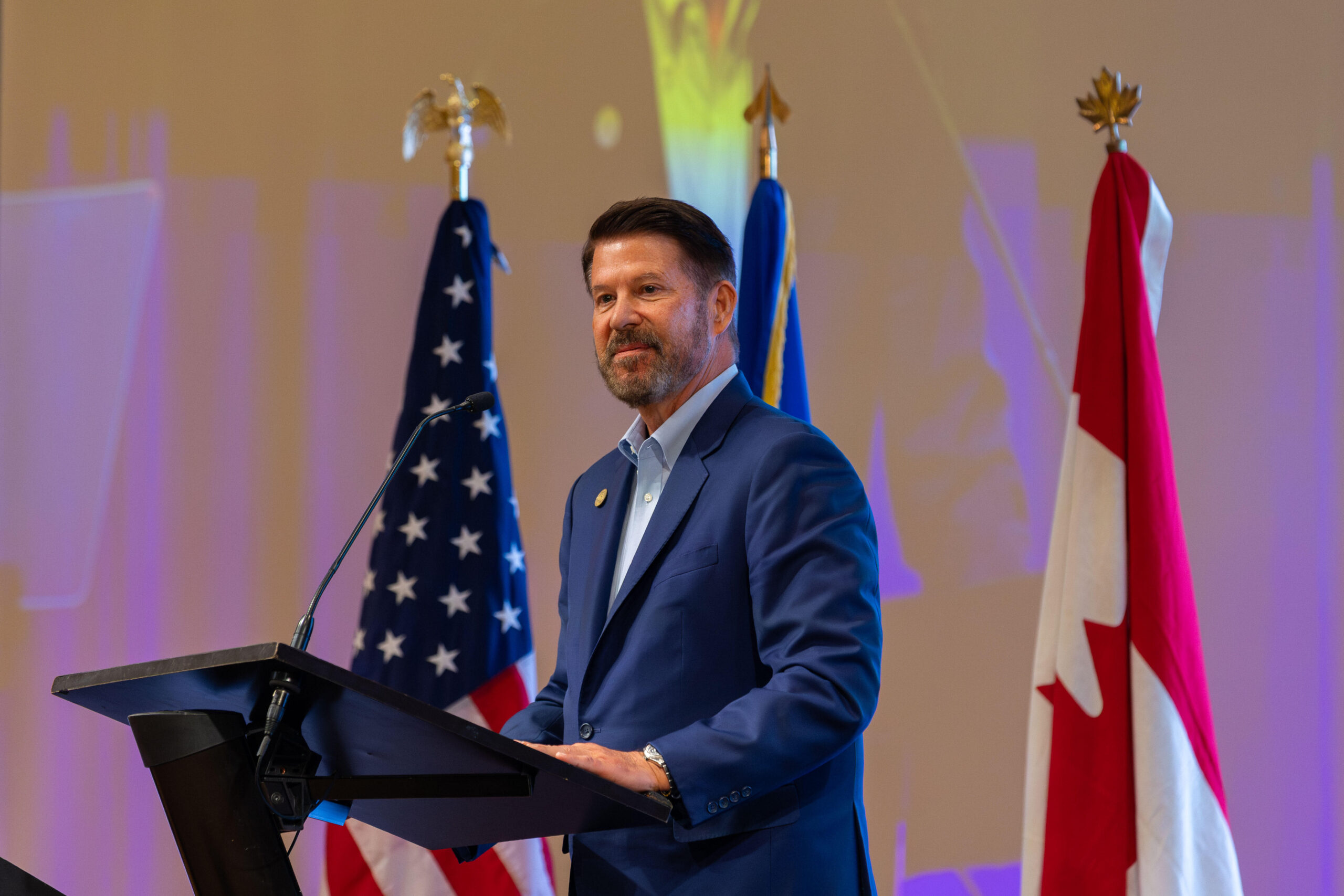

At the intersection of business, diplomacy, and civic renewal.
Eight years after Life & News named Keith Krach its inaugural Transformational Leader of the Year, Krach is focused on a new kind of transformation: helping renew America’s civic spirit for the next 250 years.

The 2018 recognition honored his leadership across business, technology, education, philanthropy, and public service. A year later, Life & News named the award after him, establishing the “Krach Transformational Leader of the Year Award” to recognize leaders whose work improves lives through innovation, service, and purpose.
Today, as CEO of Freedom 250, Chairman and Co-Founder of the Krach Institute for Tech Diplomacy at Purdue, and former U.S. Under Secretary of State, Krach is focused on helping Americans mark the nation’s 250th anniversary not simply as a commemoration of the past, but as a call to renew the principles that will shape the country’s future.
A longtime entrepreneur and public servant, Krach’s career has been recognized by Purdue University for industry leadership, public service, and philanthropy. The nation’s 250th is not simply a date on the calendar. It is an opportunity to ask a deeper question: what must this generation do to preserve, strengthen, and pass on freedom?
From the Machine Shop to the Global Stage
Krach’s story begins far from boardrooms and diplomatic summits. Raised in Rocky River, Ohio, he began working at age 12 in his father’s machine shop. The lessons from that shop stayed with him: respect the people doing the work, solve real problems, show up with humility, and understand that leadership is earned through service.
Those values carried him to Purdue University, where he studied industrial engineering, and later to Harvard Business School. At General Motors, Krach became one of the company’s youngest vice presidents and helped lead GMF Robotics, a joint venture with Fanuc that advanced industrial automation at a pivotal time for American manufacturing.
It was an early glimpse of what would become a recurring theme in Krach’s career: transformation happens when technology, trust, and human leadership come together.
From Ariba to DocuSign: Building Trust at Scale
Krach went on to co-found Rasna Corporation, a mechanical design automation company later acquired by Parametric Technology Corporation. He then co-founded Ariba, where he served as Chairman and CEO and helped pioneer business-to-business e-commerce.
At DocuSign, Krach helped turn a simple but powerful idea into a global standard: agreements could be executed securely, legally, and digitally. That transformation changed how companies, governments, and individuals conduct business.
But the heart of DocuSign was never just software. It was trust.
Every digital agreement depends on confidence: confidence in identity, security, authenticity, and enforceability. Under Krach’s leadership, DocuSign helped millions of people and organizations move from paper-based processes to trusted digital transactions.
That experience shaped one of Krach’s central convictions: trust is not a soft value. It is infrastructure.
Technology Diplomacy and the Trust Doctrine
Krach carried that conviction into public service when he served as U.S. Under Secretary of State for Economic Growth, Energy, and the Environment. In that role, he worked at the intersection of economic security, technology, energy, global partnerships, and democratic values.
His Atlantic Council expert profile describes Krach as a Silicon Valley innovator and public servant whose work spans Ariba, DocuSign, the State Department, the Clean Network, Taiwan, semiconductor supply chains, and the Krach Institute for Tech Diplomacy at Purdue.
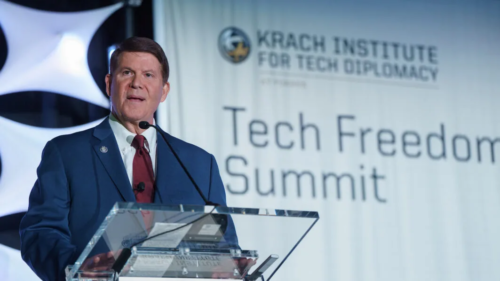
One of the defining initiatives of his tenure was the Clean Network, a coalition built around trusted technology infrastructure and the protection of data privacy, security, human rights, and principled collaboration.
The Clean Network reflected what Krach has called the Trust Doctrine: the idea that trust is the most important currency in every relationship, whether between individuals, companies, institutions, or nations.
Krach has continued to make that case in international forums and interviews, including a 2026 conversation with Decode39 on why trusted technologies matter to democratic allies. His message is that trusted technology is not only a national-security issue. It is also an alliance issue, an economic issue, and a freedom issue.
That doctrine continues to guide the Krach Institute for Tech Diplomacy at Purdue, which is dedicated to advancing freedom through trusted technology. The Institute’s work recognizes that technologies such as artificial intelligence, semiconductors, quantum computing, telecommunications, energy systems, and digital platforms are no longer merely commercial tools. They are central to national security, economic resilience, and human freedom.
Krach’s message is straightforward: technology will shape the future, but values will determine whether that future strengthens freedom or undermines it.
Why Trust Matters in the Age of AI
America’s next 250 years will be shaped by technologies that are developing faster than many institutions can adapt. Artificial intelligence is transforming how people learn, work, govern, communicate, and make decisions. Advanced manufacturing is redefining supply chains. Semiconductors and telecommunications are becoming strategic assets. Data security and privacy are essential to public confidence.
Krach has written on leadership, innovation, and freedom through his Forbes contributor page, with commentary focused on trusted technology, entrepreneurship, and the principles that allow free societies to innovate.
A recurring theme in Krach’s public work is that America’s greatest advantage is not technology alone. It is the trust system that allows technology to flourish: rule of law, property rights, transparency, open inquiry, strong universities, trusted capital markets, entrepreneurship, and alliances with other free societies.
That is why his work connects innovation with values. Trusted technology is not only about better tools. It is about protecting the conditions that make free societies possible.
Freedom 250: A Civic Transformation
Today, Krach’s work as CEO of Freedom 250 brings his leadership journey into a new chapter.
Freedom 250 is tied to one of the most important milestones in American history: the 250th anniversary of the United States. In a C-SPAN Washington Journal interview on Rededicate 250, Krach discussed the importance of bringing Americans together around the nation’s founding ideals, civic renewal, and the responsibilities of freedom.
In a Spectator profile on America’s 250th birthday, Krach described Freedom 250’s mission as creating “a movement for the next 250 years” focused on honoring the past, bringing the country together, and launching America’s next chapter with confidence.
Freedom 250 has framed the anniversary as a once-in-a-generation opportunity to honor the nation’s founding ideals, celebrate service and sacrifice, and inspire the next generation to understand the responsibilities of citizenship.
In a recent Fortune essay on America’s 250th anniversary, Krach argued that one of America’s greatest advantages is the freedom to fail, the cultural and economic permission to take risks, learn from setbacks, and build again. That idea connects directly to the Freedom 250 mission: celebrating not only America’s history, but the conditions that make American renewal possible.
From Industry Leadership to Civic Purpose
When Life & News first recognized Krach in 2018, the focus was on a career defined by industry transformation. Today, that same leadership pattern is being applied to a broader civic mission: helping Americans renew the trust, freedom, and shared purpose that will shape the nation’s next chapter.
More recently, Advanced Manufacturing magazine described Krach’s impact as “America’s $4.5-Trillion Manufacturing Man”, highlighting a career that has touched robotics, engineering automation, e-commerce, digital trust, technology diplomacy, and American competitiveness.
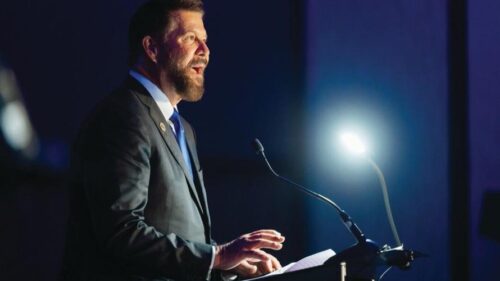
Across these roles, a consistent pattern emerges. At Ariba, Krach helped advance the shift to digital commerce. At DocuSign, he helped expand the use of trusted digital agreements. At the State Department, he helped bring technology diplomacy to the center of economic security and foreign policy. Through the Krach Institute, he has continued that work by helping leaders understand the connection between trusted technology and human freedom.
Freedom 250 brings those themes together in a civic context. The nation’s 250th anniversary is not only a moment to look back at America’s founding. It is also a moment to consider what kind of country Americans want to build for the next generation.
Across Krach’s career, the common thread has been trust: trust between people, trust in institutions, trust in technology, trust among allies, and trust in the enduring promise of freedom.
The Leadership Lesson: Building Around a Larger Mission
Transformational leadership is often associated with bold ideas, large organizations, and visible achievements. But Keith Krach’s career points to a deeper lesson: meaningful change begins with alignment around a mission larger than oneself.
In business, that meant building teams capable of changing how industries operate. In diplomacy, it meant building coalitions around trusted principles. In civic life, it means reminding Americans that freedom requires participation, responsibility, and renewal.
That is the leadership challenge of America’s next 250 years.
The technologies will change. The institutions will evolve. The global landscape will shift. But the central question will remain: can free societies build enough trust to meet the demands of the future?
Krach’s work reflects the view that they can.
And as America approaches its 250th anniversary, his message is that the next great transformation will not be driven by technology alone. It will be driven by citizens, communities, institutions, and leaders willing to renew the principles that made freedom possible in the first place.
America’s greatest export has never been a product, a platform, or a policy.
It is an idea.
Freedom.
And every generation must decide whether it will preserve it, strengthen it, and pass it on.
More on Keith Krach
Selected Sources
- Krach Institute Keith Krach Leadership Profile
Keith Krach — U.S. Department of State Biography - The Clean Network — U.S. Department of State
- Krach Institute for Tech Diplomacy at Purdue
- Keith Krach Accepts Post as Chairman of the U.S.-Taiwan Business Council
- DocuSign Chairman & CEO Keith Krach Honored as “Most Admired CEO”
- Purdue Alumnus Keith Krach Receives Nation’s Highest Manufacturing Honor